Roulette Layouts: Inside Bets and Outside Bets
Roulette layouts make inside bets and outside bets easy to compare: see where each wager sits, what it covers and how its table language works.
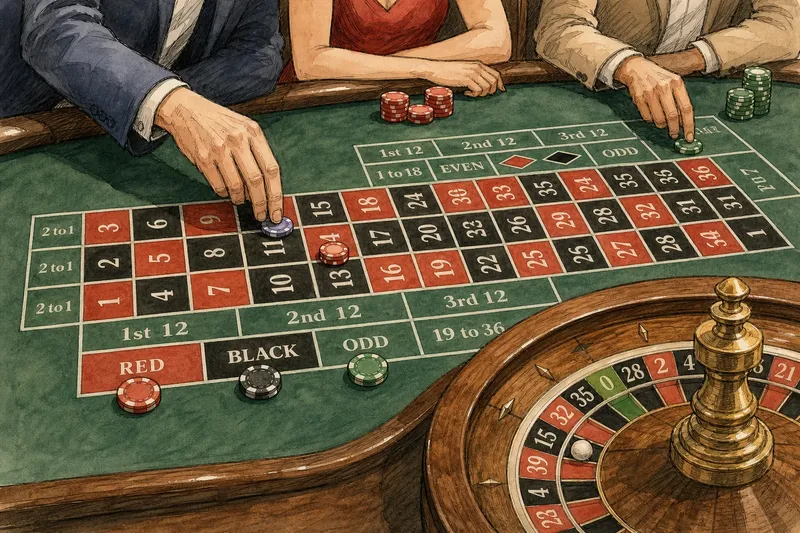
At a roulette table, a player may lean over the felt to place a chip on one number, while another sets a stack on the broad red-and-black boxes. Those positions mark the difference between inside bets and outside bets: two groups of wagers defined by where they sit on the layout and how many possible results they cover. Neither position predicts the next spin; each simply describes a different way to arrange a wager.
1. What makes a wager “inside” or “outside”?
On the standard roulette layout, the numbered grid occupies the centre. It shows the numbered pockets, commonly arranged in three vertical columns and a sequence of rows. The larger spaces around that grid hold wagers on broader categories, such as colour or odd and even numbers.
An inside bet is placed on the numbered grid, or on the lines and corners bordering it. It names one number or a small group of neighbouring numbers on the layout. An outside bet goes in one of the designated areas beyond the numbered grid and covers a broader category.
The labels describe location, not quality. “Inside” does not mean a wager is more sophisticated, and “outside” does not mean a player is standing physically outside the table. Think of the layout like a town map: a single address marks one destination, while a district label covers a larger area. Neither tells you where someone will arrive next.
2. Which wagers count as inside bets?
Inside bets include wagers on one number or compact groups of numbers. The precise shapes and names can vary with the table’s layout and rules, but the familiar types are:
- Straight-up: a chip placed on one number.
- Split: a chip placed on the line between two adjacent numbers.
- Street: a wager covering a row of three numbers.
- Corner: a wager placed at the meeting point of four numbers.
- Six line: a wager on the boundary between two adjacent rows, covering six numbers.
These names follow the geometry of the grid. A split sits between two numbered spaces; a corner touches four; a street spans one horizontal row. The chip’s position communicates the selection to the dealer, so the distinction between a space, border and intersection matters.
Because these bets cover limited sets of numbered pockets, their outcomes are more specific than those of broad outside wagers. That description is about coverage, not a method for choosing numbers. A number’s position beside another number on the felt does not make their pockets neighbours on the wheel, either: the grid and the wheel arrange numbers differently.
3. Which wagers count as outside bets?
Outside bets cover categories printed beyond the numbered grid. Common options include:
- Red or black: one of the two listed colours, excluding green zero spaces.
- Odd or even: one of the two parity groups, also excluding zero.
- High or low: a lower or upper range of numbered outcomes, with zero excluded.
- Dozen: one of three groups of twelve numbered outcomes.
- Column: one of the grid’s three vertical sequences.
These categories are broader than a single-number wager, but they are not all alike. Red and black divide the numbered pockets by colour; odd and even divide them by number properties; dozens and columns follow different groupings printed on the layout. The green zero spaces sit outside several of these categories, which is why a result of zero is not counted as red, black, odd or even.
Check whether the table uses a single-zero or double-zero wheel before comparing its layout or rules. The number of green pockets and the posted table rules affect how categories are defined and settled; follow the table’s wording where it differs.
4. How do the two groups differ in coverage?
The clearest comparison is the number of outcomes covered. A straight-up wager names one numbered pocket; a split names two; a street, corner or six line covers a small cluster. An outside wager usually covers a broader printed category, such as a colour, a half of the numbered range, a dozen or a column.
That difference shapes the feel of the layout. Inside bets make the numbered grid look like a collection of precise addresses. Outside bets make its surrounding bands read like broad labels, easy to spot and understand at a glance.
Coverage is not the same as likelihood, and neither group is a prediction tool. A broader category contains more numbered outcomes than a single-number wager, but the wheel’s green zero pocket or pockets are not part of several familiar outside groups. Read the printed layout and the table’s rules rather than treating a chip’s position as a forecast.
5. How does a chip’s position communicate the wager?
The layout is also a language shared by players and dealers. A chip placed squarely on a numbered space signals one selection; a chip set across a boundary signals a combination. Outside areas use their own marked boxes, so the intended category can be read from its location.
That visual grammar helps explain why the same chip can mean different things depending on where it lands. On a boundary, a small shift may change which numbers are covered. At a busy table, the dealer may confirm a less obvious placement; the player should make the intended area clear before the spin.
Imagine a visitor who wants to cover the two numbers printed side by side on the grid. They place a chip over the dividing line between those spaces, and the dealer can identify the split as the intended wager. The observable result is a clear two-number selection on the layout, not any special indication about what the wheel will produce.
6. What do players often ask about inside and outside bets?
Is a dozen bet an inside bet or an outside bet?
A dozen is an outside bet because it is placed in a marked area beyond the numbered grid. It covers one of the layout’s three groups of twelve numbered outcomes, rather than a small shape on the grid.
Does a zero count as red or odd?
No. Zero is green, and it is excluded from the usual red-or-black and odd-or-even categories. The exact treatment of a zero result depends on the table’s rules.
Are inside bets more difficult to place?
They can require more precise placement because some cover a border or intersection rather than one printed box. Learning the grid’s names—split, street, corner and six line—helps a player describe the intended selection.
Do outside bets predict a result better?
No. “Outside” describes a wager’s location and category, not a signal about the next spin. A broader group covers more numbered outcomes than a single-number selection, but the layout does not turn that distinction into a prediction method.
7. How can you read the layout before choosing a wager?
Start with the printed boundaries. Find the numbered grid, then locate the surrounding labels for colours, ranges, dozens and columns. If a wager sits on the grid, identify whether its chip is on a number, a border or a corner; if it sits beyond the grid, read the category written in that box.
It can also help to separate three questions that are easy to blur together: where is the chip? Which pockets does that position cover? What do the table rules say about a result? The first identifies the wager, the second describes its coverage, and the third governs settlement.
For anyone learning roulette layouts, that distinction is more useful than searching for a pattern in past spins. Inside and outside bets are two different ways to map a wager onto the felt: one points to a number or compact cluster, while the other selects a wider printed category. The layout tells you what you have chosen; it does not tell you what will happen next.