The Card Table Before the Casino Floor
The card table before the casino floor shows how household, tavern and club settings shaped access, spectatorship and authority without one route to casinos.
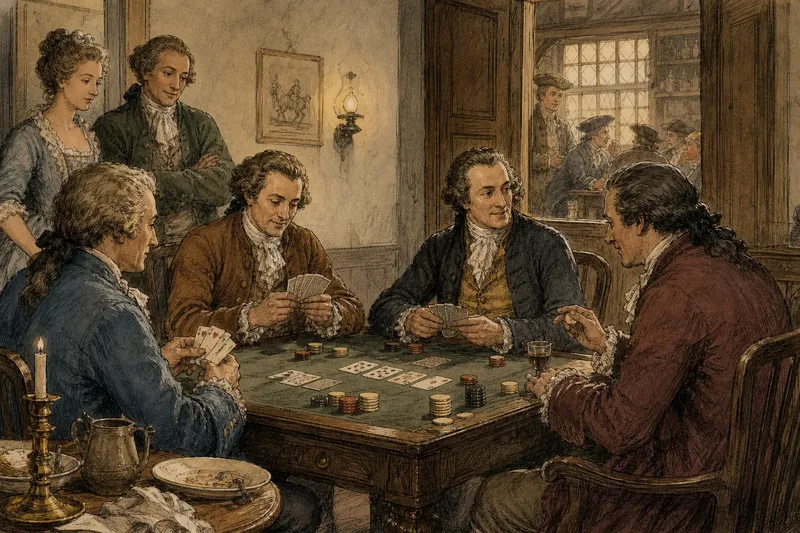
Someone shifts the supper plates to make room for a pack of cards. The card table before the casino floor might sit in a household, a tavern or a club, and each setting shaped who could join, who watched and who directed the game.
There was no single European route from a private game to a purpose-built gambling room. The terms varied by region and period, so it is safer to compare distinct settings than to tell a smooth story of progress. A room’s owner, guests and rules of entry all influenced the occasion.
What did a card table offer beyond a game?
A table brought players together around cards, counters and, where present, wagers. It also organised attention. A household host might invite acquaintances, a tavern could draw customers sharing a room, and a club could make membership part of access.
Cards did not always make gambling the main event. They could accompany conversation or leisure; elsewhere, the contest and stakes could take precedence. The same pack did not make these gatherings socially interchangeable.
A card table was a little like a kitchen table: its edges marked who was included in the conversation. Seating, invitations and the presence of onlookers helped distinguish players from spectators.
How did a room shape the evening?
In a household, the host controlled invitations and could pause play for conversation or other business. In a tavern or coffeehouse, players shared space with other customers. In a club or fashionable assembly, entry and conduct could follow more formal expectations. These are useful distinctions, not a claim that every European gathering followed the same pattern.
Say a fictional host invites four acquaintances to play a familiar card game at home. The host chooses who sits down and when to pause. If the group instead meets in a tavern, other customers can watch and the proprietor may set conditions for use of the room; in a club, membership customs may determine who enters. The observable difference is the guest list, audience and source of authority, not necessarily the cards.
This invented comparison is not a historical case or a sequence that all games followed. It shows how different arrangements could exist side by side.
What made play intelligible across gatherings?
Players needed shared conventions for dealing, taking turns, using terms and resolving disagreements. Those conventions could vary from one gathering to another, so a custom familiar at one table might need explanation at the next. Rather than treating these as a universal historical checklist, it is more accurate to see them as questions that a particular group’s practices had to answer.
- Turn order: If a surviving description or set of rules names who acts next, that supports a specific account of turn-taking; if it does not, avoid claiming a fixed order for that gathering.
- Game vocabulary: If a source explains terms used at the table, describe those terms in that setting; if it leaves them unclear, do not assume another group used the same meanings.
- Cards and counters: If an account identifies cards, counters or other equipment, name only what it records; if the equipment is unspecified, keep the description general.
- Conduct: If a period account states expectations for behaviour, connect them to its named place and group; if it gives no such detail, do not present a general etiquette as established fact.
- Rule authority: If a record identifies a host, proprietor or organiser as responsible for decisions, say so for that setting; if it does not, leave the dispute procedure open rather than assigning authority.
- Access to seats: If a source records invitations, membership or another condition of entry, describe that condition; if access is not documented, avoid deciding who could join.
These distinctions help keep a description tied to evidence. Later venues could formalise some practices, but that does not mean they simply copied every earlier table custom.
Who could play, and who could only watch?
Access depended on the gathering and its time and place. A household could limit play to invited guests, while a club might restrict entry through membership. A commercial room could draw people beyond one household or circle, yet still reflect inequalities in its surrounding society. Money, reputation, gender and class could shape welcome and credibility, though the details should not be treated as uniform across Europe.
A shared pack and turn-taking might make a hand feel orderly among its players, but they did not erase differences beyond the table. Spectators, too, shaped the occasion: they could follow the action and learn local expectations without taking a seat.
How did organised gaming rooms differ?
A dedicated gaming venue could centre its space and management on play, bringing procedures and oversight into closer relation with gambling. Taverns and clubs also managed guests and conduct, but their purposes were not necessarily organised around gaming in the same way.
This contrast is not a claim that every casino descended directly from domestic card play. Public amusements and organised gambling had varied histories; household, tavern and club games could remain social activities in their own right. Familiar practices might be adapted in later venues without forming a single, inevitable chain of development.
What do readers ask about the card table before the casino floor?
Why could cards fit into ordinary rooms?
A pack could be carried and used on a table already in the room, so play did not require a dedicated hall. Dealing and turns gave participants a shared focus amid other activities.
Did European card gatherings share one set of rules?
No single set of rules or social customs applied across every region, period and group. The conventions belonged to particular games and gatherings, and could differ from those at another table.
What role did onlookers have?
Spectators could follow a hand and observe how people behaved around the table. Their presence made a game visible to those who were not taking a turn, though the role of onlookers varied by setting.
Was the casino a direct descendant of the household card table?
Not in a simple, uninterrupted line. Later venues could adapt familiar practices, but organised gambling also drew on other traditions and arrangements.
What can the room tell us?
To understand the card table before the casino floor, ask who controlled entry, who could watch and who held authority over play. The answers, when documented for a particular place and period, reveal how a gathering balanced hospitality, commerce or membership.
A household table, tavern gathering and club room were not merely smaller versions of a casino. Their social terms differed with the room, and a careful account keeps those differences visible rather than turning them into a single origin story.